Short answer: pick an emergency-fund account in this order. First, it must be insured: FDIC for banks, NCUA for credit unions. Second, you must be able to move the money to your checking account quickly, with no withdrawal limits that bite. Third, it should have no monthly fee or minimum balance that eats the interest. Only then compare the annual percentage yield (APY), and check that the advertised APY is the ongoing rate you will actually earn, not a promotion or a tier you won’t reach.
Written for US savers. Rules and rates below were checked on October 29, 2026 against the FDIC, NCUA, Federal Reserve and Consumer Financial Protection Bureau sources listed at the end. We don’t name specific banks’ rates because they change often and we haven’t verified current ones directly.
Why the account matters more than the rate
An emergency fund has one job: be there, in full, when something goes wrong. Yield is a bonus. The difference is still worth having. The FDIC’s national average rate for savings accounts was 0.38% as of October 19, 2026. On a $20,000 fund that’s about $76 a year. At a hypothetical 3.5% APY it would be about $700.
| Balance | At 0.38% (FDIC national average, savings) | At a hypothetical 3.5% APY |
|---|---|---|
| $10,000 | $38 a year | $350 a year |
| $20,000 | $76 a year | $700 a year |
| $40,000 | $152 a year | $1,400 a year |
1. Check the deposit insurance
At a bank, look for FDIC insurance. The FDIC says its insurance covers $250,000 per depositor, per FDIC-insured bank, for each account ownership category. Savings accounts, money market deposit accounts and CDs are covered; stocks, bonds, mutual funds and crypto assets are not. You can confirm a bank is insured with the FDIC’s BankFind tool.
At a credit union, look for NCUA insurance. The NCUA says share accounts at a federally insured credit union get at least $250,000 in coverage, backed by the National Credit Union Share Insurance Fund and the full faith and credit of the US government.
If your emergency fund and other cash at one bank add up to more than $250,000 in a single ownership category, the excess isn’t insured. Splitting it across banks or ownership categories is the usual fix.
2. If it’s an app, find the bank behind it
Many high-yield accounts are offered by apps that aren’t banks. The FDIC is direct about this: nonbank companies themselves are never FDIC-insured, and deposit insurance doesn’t protect you if the nonbank company becomes insolvent. Your money is eligible only once the company deposits it at an insured bank, and so-called pass-through coverage depends on records that identify who owns how much.
Before you deposit, find the name of the bank that holds the money, check it in BankFind and read the disclosures. For money you might need at short notice, the FDIC also warns that getting it back after a nonbank fails can take time.
3. Make sure you can get to the money
The Federal Reserve removed the six-per-month limit on convenient transfers and withdrawals from savings accounts in April 2020. Its rule let banks stop enforcing the limit; it didn’t require them to, so some banks still set their own. Check the account agreement for:
- any limit on withdrawals or transfers a month, and the fee for going over it;
- how long a transfer to your checking account takes, and whether there’s a daily dollar cap;
- whether you can link the checking account you actually use.
4. Rule out fees and minimums
A monthly fee can cancel the interest. A $5 monthly fee is $60 a year, as much as a $20,000 balance earns at 0.30%. Look for no monthly maintenance fee, no minimum balance to open or to earn the advertised rate, and no fee for outgoing transfers you’ll use.
5. Read the conditions behind the APY
Compare APYs, not interest rates. Under the Truth in Savings rules, the annual percentage yield reflects the total interest paid on an account based on the interest rate and how often it compounds over a 365-day year, so it puts accounts on the same footing. Then check what it takes to earn it:
| Condition | What to look for |
|---|---|
| Introductory rate | A higher rate for the first months that then drops. Compare the rate that applies afterwards. |
| Balance tiers | The top APY only on part of the balance, or only above or below a set amount. |
| Activity requirements | The rate depends on a direct deposit, card spending or a linked account each month. |
| Fixed or variable | Whether the bank can change the rate, and how it tells you. |
Savings account or money market fund?
Brokerages often hold cash in money market funds. They’re mutual funds, not deposits, so the FDIC doesn’t insure them. A common setup is an insured savings account for the emergency fund and a money market fund for cash that’s waiting to be invested. Our brokerage comparison shows where Fidelity, Vanguard and Schwab put uninvested cash.
How big should the fund be?
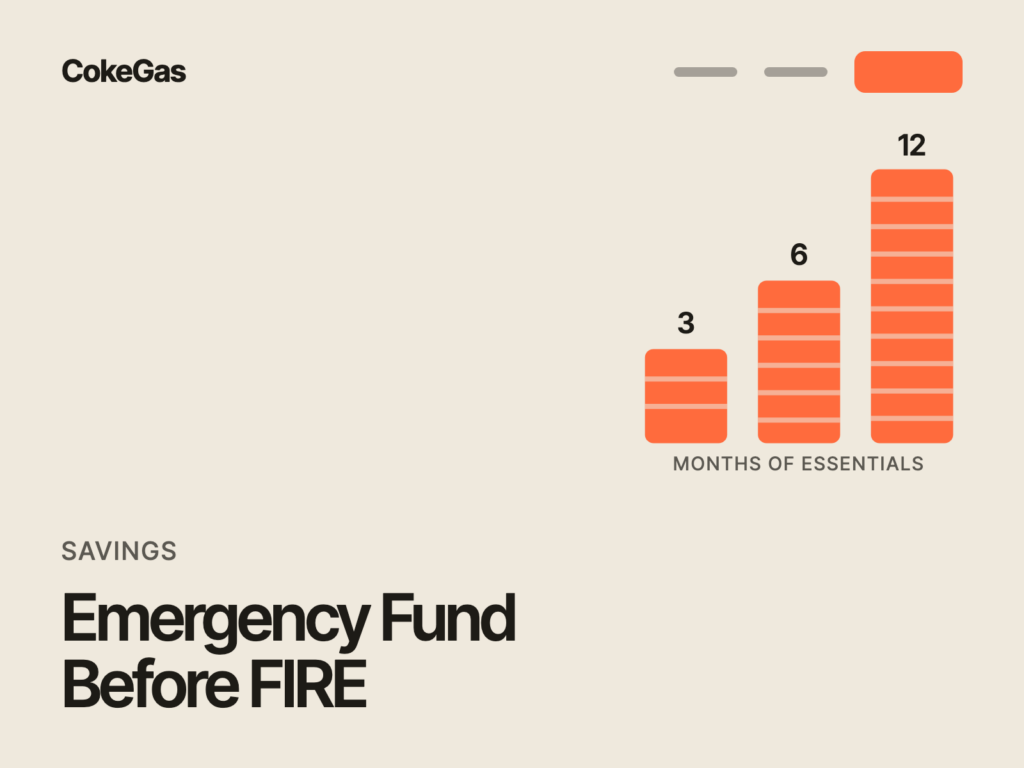
There’s no official number; it depends on your essential costs, how stable your income is and who relies on it. Emergency fund before FIRE works through 3, 6 and 12 months of essential expenses, with what each costs in time to financial independence. The FIRE calculator treats this money as separate from your investments, so leave it out of “Already invested”.
Sources
- FDIC, Understanding deposit insurance.
- FDIC, Banking with third-party apps.
- FDIC, National rates and rate caps, as of October 19, 2026 (savings rates based on the $2,500 product tier).
- NCUA, Share insurance coverage.
- Federal Reserve Board, interim final rule amending Regulation D, April 24, 2020.
- Consumer Financial Protection Bureau, Regulation DD (Truth in Savings) § 1030.2, definitions.
Related reading: how much to keep in your emergency fund, Start Here for where it fits in a FIRE plan, and how your savings rate changes your timeline.