Short answer: a three-fund portfolio is a US total stock market index fund, an international stock index fund and a US bond index fund, held in proportions you choose and rebalanced now and then. It owns thousands of companies and bonds for a weighted cost that can be under 0.03% a year, and it takes minutes to run. It doesn’t decide your stock-to-bond mix for you, and it can still lose money: diversification spreads risk, it doesn’t remove it.
The three funds
Each fund tracks a broad index, so together they cover most of the investable stock market and the US investment-grade bond market. Here is one example lineup using Fidelity’s index funds, with costs from their summary prospectuses. Vanguard and Schwab offer equivalents; any provider’s low-cost broad index funds do the same job.
| Role | Example fund | Index it tracks | Expense ratio |
|---|---|---|---|
| US stocks | Fidelity Total Market Index (FSKAX) | Dow Jones U.S. Total Stock Market Index | 0.015% |
| International stocks | Fidelity Total International Index (FTIHX) | MSCI ACWI ex USA Investable Market Index | 0.06% |
| US bonds | Fidelity U.S. Bond Index (FXNAX) | Bloomberg U.S. Aggregate Bond Index | 0.025% |
What it costs, worked out
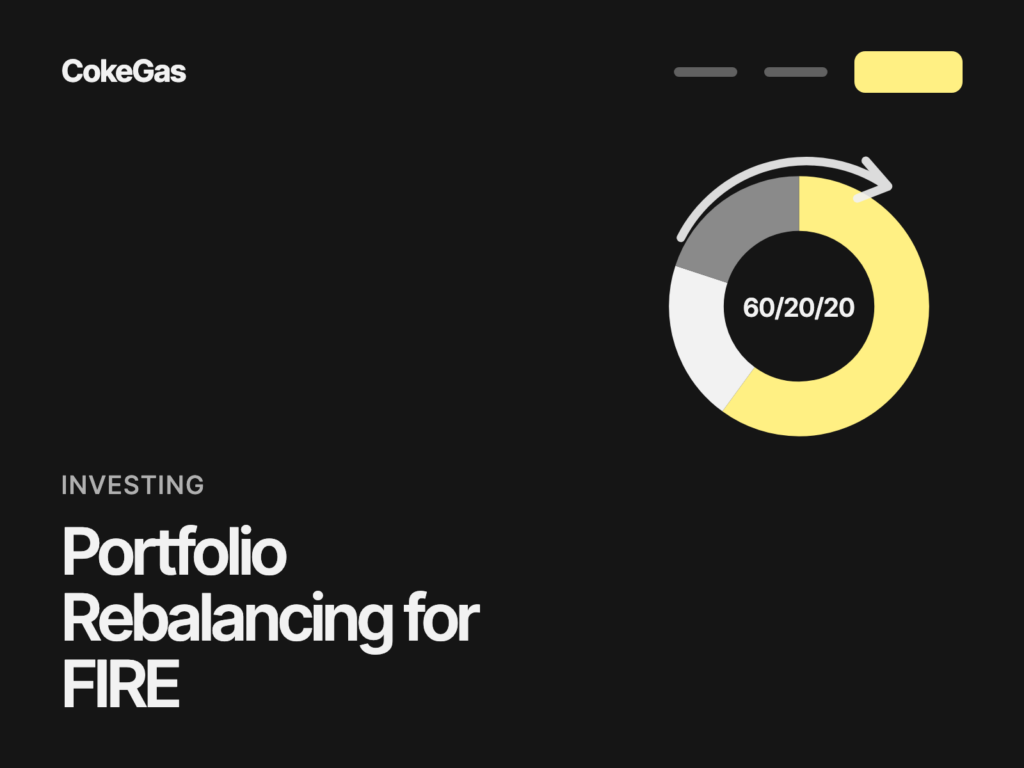
Your total cost is the weighted average of the three expense ratios. With 60% in US stocks, 20% international and 20% bonds:
0.60 × 0.015% + 0.20 × 0.06% + 0.20 × 0.025% = 0.009% + 0.012% + 0.005% = 0.026% a year, or $26 a year for every $100,000 invested.
For comparison, a 1% advisory fee on the same $100,000 is $1,000 a year. Our fees guide shows what that difference does to a FIRE date over decades.
Choosing the mix
The three-fund idea tells you what to own, not how much of each. The SEC’s beginner guide describes asset allocation as dividing a portfolio among asset categories such as stocks, bonds and cash, and notes that all investments carry some risk. Two questions drive the split:
- Stocks versus bonds. More stocks has historically meant higher long-run returns and deeper falls along the way; more bonds, the reverse. Morningstar’s review of rolling 30-year periods since 1926 found higher-equity portfolios generally delivered better returns, with much wider swings in outcomes (The State of Retirement Income: 2025). Early in a long accumulation phase many FIRE savers hold mostly stocks; nearer retirement, bonds can cushion the early years of withdrawals (see sequence-of-returns risk).
- US versus international. International stocks add companies the US funds don’t own, and with them currency movements. How much to hold is a judgment call; pick a share you’ll stick with.
Whatever you choose, write it down. A target you decided in advance is easier to keep when markets are falling.
Where to hold each fund
Most FIRE savers have several accounts: a 401(k), an IRA and a taxable brokerage account. You don’t need all three funds in each one; treat them as one portfolio and place funds where taxes hurt least.
- Taxable account: stock index funds are often a good fit, because their dividends can be “qualified” and taxed at the lower capital gain rates (IRS Topic 404).
- Tax-advantaged accounts: bond funds pay out mostly interest, which doesn’t get that lower rate, so many investors hold bonds in a 401(k) or IRA first.
- Your 401(k)’s menu decides a lot. If the plan has a cheap bond or total-market fund, build around it; if every option is expensive, put only what you must there.
Rebalancing
Markets drift your mix away from the target. The SEC defines rebalancing as bringing a portfolio back to its original allocation. The cheapest way is to direct new contributions to whichever fund is under its target; selling in a taxable account can trigger capital gains tax. Portfolio rebalancing for FIRE walks through a three-fund example, calendar versus threshold rules and the tax trade-offs.
Limitations
- It falls with the market. A broad index fund owns the whole market, including the bad years.
- Bonds aren’t risk-free. Bond fund prices fall when interest rates rise.
- It needs you to act. Unlike a target-date fund, nothing rebalances or shifts toward bonds automatically.
- The cheapest version depends on your provider. Some index funds are cheapest or only available at their own firm; buying them elsewhere can cost a transaction fee. Our brokerage comparison lists those fees.
Sources
- Fidelity Total Market Index Fund, summary prospectus, April 29, 2026.
- Fidelity Total International Index Fund, summary prospectus, December 30, 2025.
- Fidelity U.S. Bond Index Fund, summary prospectus, October 30, 2026.
- SEC, Beginners’ Guide to Asset Allocation, Diversification, and Rebalancing.
- IRS, Topic no. 404, Dividends (last reviewed October 8, 2026).